Personalization at Scale: Boost Customer Engagement 10% by 2026
In the rapidly evolving landscape of digital marketing, capturing and retaining customer attention is more challenging than ever. Consumers are bombarded with information, and their expectations for relevant, timely, and personalized experiences are continuously rising. Generic marketing messages no longer cut through the noise. The future, and indeed the present, belongs to brands that can master personalization at scale. This isn’t just a buzzword; it’s a strategic imperative for any business aiming to thrive in the digital age. Our focus today is not just on understanding personalization, but on leveraging it to drive a tangible 10% increase in customer engagement through digital marketing by 2026.
The promise of personalization has been around for years, but the ability to deliver truly individualized experiences to millions of customers simultaneously has been the elusive holy grail. Thanks to advancements in data analytics, artificial intelligence (AI), and marketing automation, achieving genuine personalization at scale is now within reach. This comprehensive guide will delve into what it takes to implement such a strategy, the technologies that enable it, the challenges you might face, and the immense benefits you can reap, particularly in boosting customer engagement.
Understanding Personalization at Scale: More Than Just a Name
Before we dive into the ‘how,’ let’s clarify ‘what.’ Personalization at scale is the ability to deliver unique, relevant, and timely experiences to individual customers across all touchpoints, using automated processes and data-driven insights, without sacrificing efficiency or quality. It goes beyond simply addressing a customer by their first name in an email. It involves understanding their preferences, behaviors, purchase history, and even their current context (e.g., location, device, time of day) to tailor every interaction.
The Evolution of Personalization
Historically, personalization was a manual, segment-based effort. Marketers would create a few broad customer segments and tailor messages for each. While a step up from mass marketing, this approach still treated groups of people as monolithic entities. The next stage involved dynamic content insertion, where certain elements of a communication changed based on basic user data. Today, true personalization at scale leverages advanced analytics and AI to create a ‘segment of one,’ delivering hyper-relevant content, product recommendations, and offers in real-time.
Why is Personalization at Scale Crucial for Engagement?
Customer engagement is the lifeblood of any successful business. It leads to increased loyalty, higher conversion rates, and stronger brand advocacy. When customers feel understood and valued, they are more likely to interact with your brand, spend more, and become advocates. Generic messages, conversely, can lead to disinterest, unsubscribes, and ultimately, customer churn. By delivering personalized experiences, you:
- Increase Relevance: Customers see content that matters to them, making them more likely to pay attention.
- Build Trust: Showing you understand their needs fosters a sense of trust and connection.
- Improve User Experience: A tailored journey feels smoother and more intuitive.
- Drive Action: Relevant calls-to-action are more likely to be clicked.
- Boost Loyalty: Customers who feel valued are more likely to stick with your brand.
Our goal of a 10% increase in customer engagement by 2026 is ambitious but entirely achievable with a robust personalization at scale strategy.
The Pillars of Effective Personalization at Scale
Achieving true personalization at scale requires a multi-faceted approach built upon several key pillars:
1. Data Collection and Management: The Foundation
You cannot personalize without data. This pillar involves gathering comprehensive customer data from every possible touchpoint – website visits, app usage, purchase history, email interactions, social media engagement, customer service interactions, and even third-party data. But collection is only half the battle. Effective data management involves:
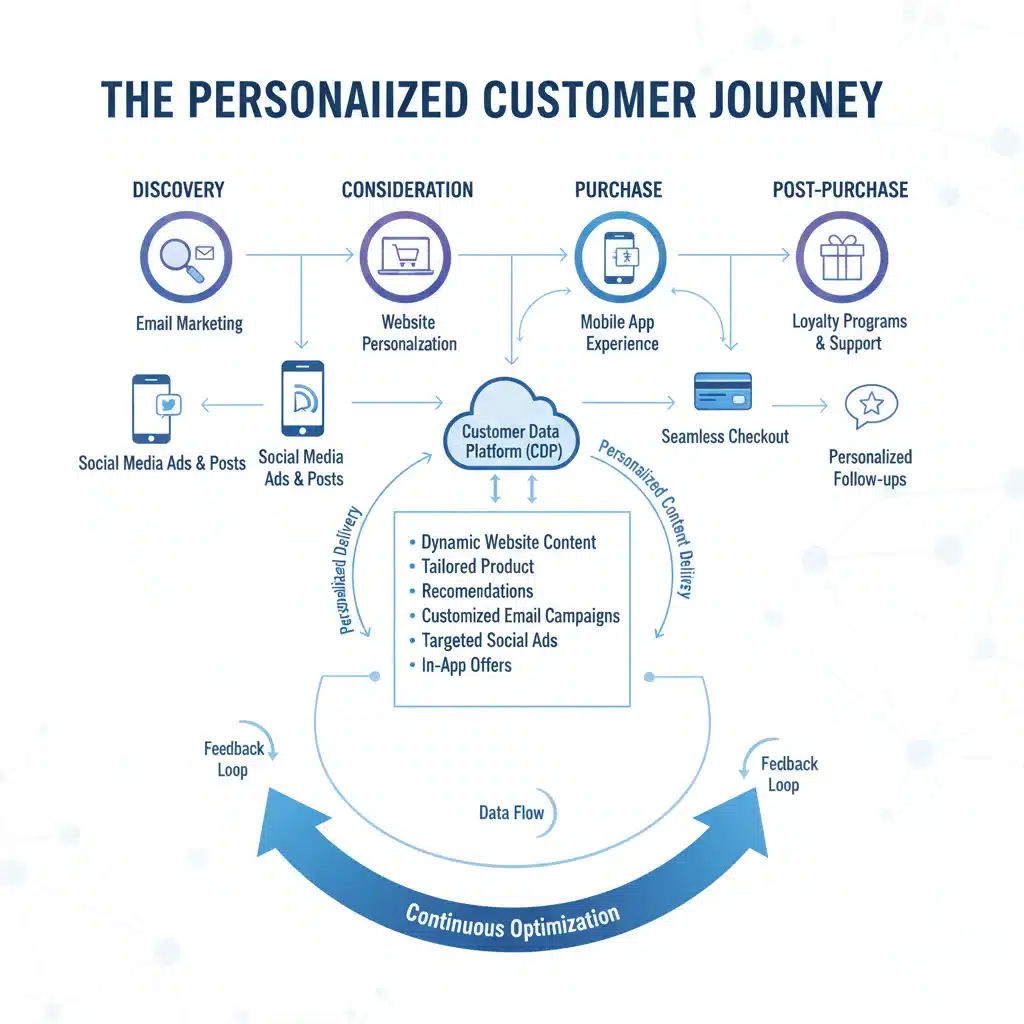
- Data Unification: Breaking down data silos to create a single, unified customer view (often through a Customer Data Platform – CDP).
- Data Quality: Ensuring data is accurate, up-to-date, and complete.
- Data Privacy and Compliance: Adhering to regulations like GDPR and CCPA, building trust through transparent data practices.
- Data Segmentation and Enrichment: Segmenting audiences dynamically and enriching profiles with additional insights.
Without a solid data foundation, any personalization efforts will be superficial and ineffective.
2. Advanced Analytics and AI: Making Sense of the Data
Once you have the data, you need to understand it. This is where advanced analytics and AI/Machine Learning (ML) come into play. These technologies are critical for:
- Predictive Analytics: Forecasting future customer behavior, such as churn risk or next best offer.
- Behavioral Analysis: Identifying patterns and trends in customer interactions.
- Real-time Personalization: Delivering dynamic content and recommendations in milliseconds based on current user context.
- Automated Segmentation: Dynamically creating and refining customer segments based on evolving behaviors.
- Content Optimization: AI can help determine which content performs best for which audience segments.
AI is the engine that drives true personalization at scale, enabling marketers to move beyond static rules to dynamic, adaptive experiences.
3. Marketing Automation and Orchestration: Delivering the Experience
Even with great data and insights, you need the tools to deliver personalized experiences across various channels. Marketing automation platforms (MAPs) and orchestration tools allow you to:
- Automate Workflows: Trigger personalized emails, push notifications, or website content based on specific customer actions or inactions.
- Orchestrate Customer Journeys: Design complex, multi-channel customer journeys that adapt in real-time.
- Cross-Channel Consistency: Ensure a consistent and coherent personalized message across email, web, mobile, social, and even offline channels.
- A/B Testing and Optimization: Continuously test and refine personalized elements to maximize their impact.
This pillar ensures that your insights are translated into actionable, personalized communications that reach the customer at the right time and place.
Implementing Personalization at Scale: A Step-by-Step Guide
Embarking on a journey towards personalization at scale can seem daunting, but by breaking it down into manageable steps, you can build a robust strategy.
Step 1: Define Your Personalization Goals and KPIs
What do you want to achieve? Our overarching goal is a 10% increase in customer engagement by 2026. Break this down into measurable KPIs: increased email open rates, higher click-through rates, reduced bounce rates, increased time on site, higher conversion rates, improved customer satisfaction scores (CSAT), and reduced churn. Clearly defined goals will guide your strategy and allow you to measure success.
Step 2: Audit Your Current Data Infrastructure and Capabilities
Assess your existing data sources, CRM, CDP, marketing automation platforms, and analytics tools. Identify gaps in data collection, integration, and analysis. Do you have a unified customer profile? Are you able to track customer journeys across channels? This audit will highlight areas needing improvement or investment.
Step 3: Invest in the Right Technology Stack
To achieve true personalization at scale, you will likely need a robust tech stack. This typically includes:
- Customer Data Platform (CDP): To unify customer data from various sources.
- AI/ML-powered Personalization Engine: For real-time recommendations, predictive analytics, and dynamic content delivery.
- Marketing Automation Platform (MAP): For orchestrating campaigns across channels.
- A/B Testing and Optimization Tools: To continuously improve personalization effectiveness.
Choose platforms that integrate well with your existing systems and scale with your needs.
Step 4: Develop a Comprehensive Data Strategy
Outline how you will collect, store, process, and utilize customer data. This includes defining data governance policies, ensuring compliance with privacy regulations (GDPR, CCPA), and establishing clear data ownership. A strong data strategy is the bedrock of ethical and effective personalization.
Step 5: Start Small, Learn, and Expand
Don’t try to personalize everything at once. Begin with a specific use case or customer segment where you can demonstrate quick wins. For example, start with personalized product recommendations on your website, or tailored email sequences for new subscribers. Analyze the results, learn what works and what doesn’t, and then gradually expand your personalization at scale efforts to other channels and customer segments.
Step 6: Create Dynamic Content and Offers
Personalization is only as good as the content it delivers. Invest in creating a library of dynamic content elements that can be assembled and delivered in various combinations based on individual customer profiles. This includes personalized product images, text snippets, calls-to-action, and offers. The more modular your content, the easier it is to personalize at scale.
Step 7: Monitor, Analyze, and Optimize Continuously
Personalization at scale is not a set-it-and-forget-it strategy. It requires continuous monitoring of performance metrics, A/B testing different approaches, and refining algorithms and content based on insights. Use analytics to identify what drives engagement and what falls flat, then iterate and improve. This iterative process is key to achieving and sustaining that 10% engagement increase.
Real-World Applications of Personalization at Scale
Let’s look at how personalization at scale can be applied across different digital marketing channels to boost engagement:
Website Personalization
- Dynamic Homepage Content: Displaying different hero banners, featured products, or articles based on a visitor’s past browsing behavior, purchase history, or demographic data.
- Personalized Product Recommendations: ‘Customers who bought this also bought…’ or ‘Recommended for you’ sections driven by collaborative filtering and AI.
- Location-Based Content: Showing local store information, relevant events, or localized offers.
- Exit-Intent Pop-ups: Offering personalized discounts or content based on the user’s behavior before they leave the site.
Email Marketing Personalization
- Dynamic Content Blocks: Changing product images, descriptions, or calls-to-action within a single email template based on recipient data.
- Behavior-Triggered Emails: Sending abandoned cart reminders, browse abandonment emails, or post-purchase follow-ups with relevant product suggestions.
- Personalized Subject Lines: Using data to craft subject lines that resonate more with individual recipients.
- Segmented Campaigns: While not fully individual, highly granular segmentation based on behavior and preference still offers significant personalization benefits.
Mobile App Personalization
- Push Notifications: Sending timely, relevant notifications about promotions, order status, or content updates based on user preferences and location.
- In-App Messaging: Delivering personalized messages or offers within the app interface to guide users or highlight features.
- Personalized Feeds: Curating content feeds (e.g., news, social media, product listings) based on user interests.
Social Media Personalization
- Dynamic Ads: Showing different ad creatives and copy to different audience segments based on their interests and online behavior.
- Retargeting Campaigns: Delivering personalized ads to users who have previously interacted with your website or app.
- Personalized Content Feeds: While largely controlled by platform algorithms, brands can tailor their content strategy to appeal to specific audience segments engaging with them.
Challenges and Considerations for Personalization at Scale
While the benefits are clear, implementing personalization at scale comes with its own set of challenges:
1. Data Silos and Integration Issues
Many organizations struggle with fragmented data spread across different systems (CRM, ERP, marketing automation, e-commerce). Integrating these systems to create a single customer view is often the biggest hurdle.
2. Data Privacy and Trust
Consumers are increasingly concerned about their data privacy. Brands must be transparent about data collection, provide clear opt-out options, and ensure robust security measures. Misusing data or being perceived as ‘creepy’ can severely damage brand trust and engagement.
3. Content Creation at Scale
Generating enough high-quality, dynamic content to support hyper-personalization can be resource-intensive. This requires a shift in content strategy towards modular, adaptable content components.
4. Talent and Expertise
Implementing and managing advanced personalization requires a diverse skill set, including data scientists, AI specialists, data engineers, and content strategists who understand dynamic content. Finding and retaining this talent can be challenging.
5. Measuring ROI
Attributing specific engagement increases or revenue gains directly to personalization efforts can be complex, especially in multi-touchpoint customer journeys. Robust attribution models and analytics are crucial.
The Future of Personalization: Beyond 2026
As we look towards 2026 and beyond, personalization at scale will continue to evolve:
- Hyper-Personalization with Generative AI: AI will not only deliver existing content but also generate unique content (text, images, even video) on the fly for individual users.
- Proactive Personalization: Systems will anticipate customer needs and deliver solutions before the customer even realizes they have a problem.
- Voice and Conversational AI: Personalization will extend seamlessly into voice assistants and chatbots, offering highly natural and intuitive interactions.
- Ethical AI and Transparency: Greater emphasis will be placed on ethical AI practices, explainable AI, and giving customers more control over their personalized experiences.
- Metaverse and Immersive Experiences: Personalization will extend into virtual and augmented realities, creating bespoke immersive brand interactions.
The brands that embrace these future trends will be those that continue to lead in customer engagement and loyalty.
Conclusion: Your Path to 10% Engagement Growth with Personalization at Scale
Achieving a 10% increase in customer engagement through digital marketing by 2026 is an ambitious yet entirely attainable goal for businesses committed to mastering personalization at scale. It requires a strategic investment in data, technology, and talent, coupled with a customer-centric mindset. By unifying your data, leveraging advanced AI and analytics, and orchestrating seamless, personalized experiences across every digital touchpoint, you can build deeper connections with your audience.
Remember, personalization is not just about making sales; it’s about building relationships. When customers feel seen, heard, and understood, they become more engaged, more loyal, and ultimately, more valuable to your brand. Start your journey today, embrace the iterative process of learning and optimization, and unlock the immense power of personalization at scale to drive your digital marketing success into the future.