Actionable AI: Boost Your Digital Marketing ROI by 20% by Q3 2026

The digital marketing landscape is in constant flux, driven by technological advancements and evolving consumer behaviors. In this dynamic environment, artificial intelligence (AI) has emerged not just as a buzzword, but as a transformative force capable of revolutionizing how U.S. digital marketers operate. The promise? A tangible, measurable increase in return on investment (ROI). This comprehensive guide is designed to equip U.S. digital marketers with the knowledge and actionable strategies to achieve a remarkable 20% ROI increase by Q3 2026 through the strategic deployment of AI. We’ll delve into the core concepts, practical applications, and the strategic roadmap necessary to turn this ambitious goal into a reality.
In an increasingly competitive market, simply participating is no longer enough. Marketers are under immense pressure to demonstrate concrete results and optimize every dollar spent. This is where AI marketing ROI becomes a critical focus. AI offers unprecedented capabilities for data analysis, personalization, automation, and predictive insights, all of which contribute directly to more efficient campaigns and higher conversion rates. By Q3 2026, the marketers who have successfully integrated AI into their workflows will not only be outperforming their competitors but will have also established a sustainable competitive advantage.
Our journey begins by understanding the foundational elements of AI in marketing, then proceeds to explore specific, actionable strategies that can be implemented across various marketing channels. We will also address the challenges and ethical considerations, ensuring a holistic approach to AI adoption. The goal is clear: empower U.S. digital marketers to leverage AI not as a hypothetical future tool, but as a present-day catalyst for significant ROI growth.
Understanding the AI Marketing Landscape: Why Now for U.S. Marketers?
The convergence of advanced algorithms, increased computational power, and vast amounts of data has created a perfect storm for AI to flourish in marketing. For U.S. digital marketers, the imperative to adopt AI is particularly strong due to the highly saturated and competitive nature of the market. Consumers are bombarded with messages, making it harder than ever to cut through the noise. AI provides the tools to deliver highly relevant, timely, and personalized experiences that resonate with individual customers, driving engagement and, ultimately, conversions.
The Evolution of AI in Marketing
Initially, AI in marketing was largely confined to basic automation tasks, such as email scheduling or simple chatbot responses. However, rapid advancements in machine learning (ML), natural language processing (NLP), and computer vision have expanded its capabilities exponentially. Today, AI can analyze complex data patterns, predict customer behavior with remarkable accuracy, generate creative content, and even optimize ad spend in real-time. This evolution means that AI is no longer just a supportive technology but a strategic imperative for any U.S. marketer aiming for significant ROI improvement.
Key AI Technologies Driving Marketing ROI
- Machine Learning (ML): At the heart of most AI applications, ML algorithms learn from data to identify patterns and make predictions without explicit programming. In marketing, this translates to predictive analytics for customer churn, personalized product recommendations, and optimized ad targeting.
- Natural Language Processing (NLP): NLP enables computers to understand, interpret, and generate human language. This is crucial for sentiment analysis of customer feedback, AI-powered content generation, and sophisticated chatbot interactions that enhance customer service and lead qualification.
- Computer Vision: While less directly applied to traditional digital marketing, computer vision plays a role in analyzing visual content, understanding consumer interactions with physical products, and even enhancing visual search capabilities for e-commerce.
- Predictive Analytics: This AI subset uses historical data to forecast future outcomes. For marketers, this means predicting which leads are most likely to convert, identifying optimal times to send marketing messages, and anticipating market trends.
- Generative AI: The newest frontier, generative AI can create original content, from ad copy and blog posts to images and video scripts, significantly reducing content creation costs and speeding up production cycles. This is a game-changer for content marketing and creative development.
By understanding these core technologies, U.S. marketers can better identify opportunities to integrate AI into their existing strategies and unlock the potential for a 20% AI marketing ROI by Q3 2026.
Strategic Pillars for a 20% AI Marketing ROI Increase by Q3 2026
Achieving a 20% ROI increase is an ambitious but attainable goal with a structured approach to AI integration. This section outlines the strategic pillars that U.S. marketers should focus on.
Pillar 1: Hyper-Personalization at Scale
Generic marketing messages are a relic of the past. Consumers expect tailored experiences. AI enables hyper-personalization by analyzing vast amounts of individual customer data – browsing history, purchase patterns, demographic information, and social media activity – to deliver highly relevant content, offers, and recommendations.
Actionable AI Applications for Personalization:
- AI-Powered Content Recommendations: Utilize ML algorithms to suggest products, articles, or videos to individual users based on their past interactions and preferences. This can be implemented on websites, in emails, and within apps.
- Dynamic Ad Creative Optimization: AI can generate multiple ad variations and dynamically serve the most effective creative to specific audience segments based on real-time performance data. This significantly boosts ad relevance and click-through rates.
- Personalized Email Marketing: Beyond simple name personalization, AI can determine the optimal send time, subject line, and content for each subscriber, leading to higher open rates and conversions.
- Predictive Product Recommendations: For e-commerce, AI can predict what a customer is likely to buy next, even before they know it, leading to increased average order value (AOV).
Pillar 2: Enhanced Customer Journey Optimization
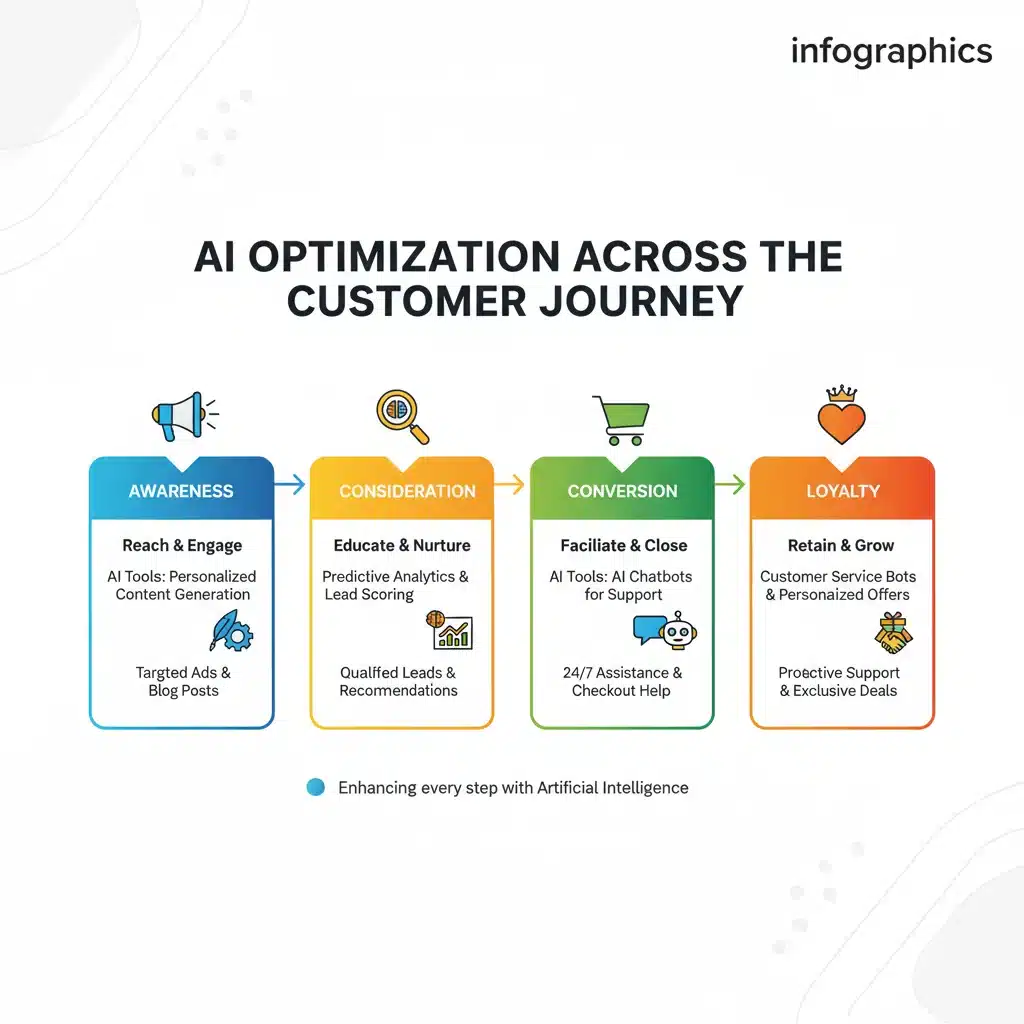
Every touchpoint in the customer journey presents an opportunity to either engage or lose a potential customer. AI provides the intelligence to optimize each stage, from initial awareness to post-purchase loyalty.
Actionable AI Applications for Customer Journey:
- AI-Driven Lead Scoring: ML models can analyze various data points to assign a score to each lead, indicating their likelihood of conversion. This allows sales and marketing teams to prioritize high-potential leads, improving efficiency and conversion rates.
- Intelligent Chatbots and Virtual Assistants: Deploy AI-powered chatbots on websites and social media to provide instant customer support, answer FAQs, qualify leads, and even guide users through the purchase process. This reduces customer service costs and improves immediate engagement.
- Sentiment Analysis for Feedback: Use NLP to analyze customer reviews, social media comments, and support interactions to gauge sentiment and identify pain points or areas for improvement, leading to better product/service offerings and customer satisfaction.
- Proactive Customer Retention: AI can predict which customers are at risk of churning and trigger targeted retention campaigns, such as personalized offers or problem-solving support, before they leave.
Pillar 3: Automated and Optimized Campaign Management
Manual campaign management is time-consuming and prone to human error. AI automates repetitive tasks and optimizes campaign performance in real-time, freeing up marketers to focus on strategic initiatives.
Actionable AI Applications for Campaign Management:
- Programmatic Advertising with AI: AI algorithms can bid on ad placements, optimize targeting, and adjust creative in real-time across various platforms, ensuring the most efficient use of ad spend and maximizing reach to the right audience.
- Automated A/B Testing and Experimentation: AI can run thousands of A/B tests simultaneously on various campaign elements (headlines, images, CTAs) and automatically implement the winning variations, continuously improving campaign performance.
- Budget Optimization: AI can analyze campaign performance across different channels and reallocate budget in real-time to the highest-performing areas, ensuring maximum ROI for every dollar spent.
- Predictive Audience Segmentation: AI can identify new, high-value audience segments based on complex data patterns that human analysis might miss, opening up new targeting opportunities.
Pillar 4: Data-Driven Insights and Predictive Forecasting
The ability to not only understand past performance but also predict future trends is invaluable. AI excels at extracting actionable insights from vast datasets and forecasting market shifts.
Actionable AI Applications for Insights:
- Market Trend Prediction: AI can analyze industry data, news, and social media conversations to predict emerging trends, allowing marketers to adapt their strategies proactively.
- Competitor Analysis: AI tools can monitor competitor activities, ad spend, and campaign performance, providing competitive intelligence to inform your own strategies.
- Attribution Modeling: AI can build more sophisticated attribution models that accurately credit each touchpoint in the customer journey, providing a clearer picture of which marketing efforts are truly driving ROI.
- Performance Anomaly Detection: AI can automatically flag unusual spikes or drops in campaign performance, alerting marketers to potential issues or opportunities that require immediate attention.
Implementing AI: A Step-by-Step Roadmap for U.S. Marketers
Achieving a 20% AI marketing ROI by Q3 2026 requires more than just understanding the potential of AI; it demands a structured implementation plan. Here’s a roadmap for U.S. marketers:
Step 1: Define Clear ROI Objectives and KPIs
Before diving into AI, clearly articulate what a 20% ROI increase looks like for your specific business. Identify key performance indicators (KPIs) that will measure this growth, such as conversion rates, customer lifetime value (CLTV), customer acquisition cost (CAC), average order value (AOV), or marketing-attributed revenue. This clarity will guide your AI strategy and help you track progress.
Step 2: Audit Existing Data Infrastructure and Capabilities
AI thrives on data. Assess your current data collection, storage, and analysis capabilities. Do you have clean, organized, and accessible data? Identify gaps in your data infrastructure and plan for improvements. This might involve integrating various data sources (CRM, analytics platforms, social media) into a unified data warehouse or customer data platform (CDP).
Step 3: Start Small, Think Big: Pilot Programs
Don’t try to implement AI across your entire marketing operation overnight. Start with pilot programs focused on specific, high-impact areas. For example, begin with AI-powered ad optimization for a single campaign or implement an intelligent chatbot for a specific customer service segment. Document results, learn from challenges, and refine your approach before scaling.
Step 4: Invest in the Right AI Tools and Talent
The market is flooded with AI marketing tools. Research and select solutions that align with your defined objectives and budget. Consider factors like ease of integration, scalability, and vendor support. Simultaneously, assess your team’s AI literacy. Invest in training existing staff or hiring new talent with AI expertise, such as data scientists or AI-savvy marketing analysts.
Step 5: Foster a Culture of Experimentation and Continuous Learning
AI is not a set-it-and-forget-it solution. It requires continuous monitoring, optimization, and experimentation. Encourage your marketing team to embrace an agile mindset, constantly testing new AI applications, analyzing results, and adapting strategies. The AI models themselves will improve over time with more data and feedback.
Step 6: Address Ethical Considerations and Data Privacy
As you leverage AI, it’s crucial to address ethical implications and ensure compliance with data privacy regulations (e.g., CCPA, GDPR, and emerging state-level privacy laws in the U.S.). Be transparent with customers about how their data is used, ensure data security, and avoid biases in AI algorithms that could lead to discriminatory marketing practices. Building trust is paramount for long-term AI marketing success.
Navigating Challenges and Maximizing Success with AI Marketing ROI
While the potential for a 20% AI marketing ROI is significant, U.S. marketers will encounter challenges during implementation. Proactive planning can mitigate these hurdles.
Common Challenges and Solutions:
- Data Quality and Integration: Poor data quality (inaccurate, incomplete, or inconsistent data) can cripple AI’s effectiveness. Invest in data cleansing tools and establish robust data governance policies. Integrate disparate data sources into a unified view.
- Skill Gap: Many marketing teams lack the specialized skills to implement and manage AI solutions. Bridge this gap through training, upskilling current employees, or strategic hires. Consider partnerships with AI consultancies for initial setup and guidance.
- Budget Constraints: AI tools and talent can be expensive. Start with cost-effective solutions or open-source AI frameworks. Demonstrate small wins and measurable ROI from pilot programs to secure further investment.
- Resistance to Change: Employees may be apprehensive about AI. Communicate the benefits clearly, emphasizing how AI can augment human capabilities rather than replace them. Involve the team in the AI adoption process.
- Measuring ROI Accurately: Attributing specific ROI to AI can be complex. Establish clear baseline metrics before AI implementation and use robust attribution models to track the impact of AI-driven initiatives.

Future Trends in AI Marketing for U.S. Marketers
Looking beyond Q3 2026, the evolution of AI will continue to shape digital marketing. Staying abreast of these trends will ensure sustained ROI growth.
- Hyper-Personalization at the Micro-Moment: AI will enable real-time, context-aware personalization, delivering messages and offers precisely when and where a customer is most receptive, even during a single browsing session.
- Advanced Generative AI for Creative: Expect AI to generate increasingly sophisticated and diverse creative content, including full video ads, interactive experiences, and even personalized virtual influencers. This will further reduce content production costs and accelerate campaign launches.
- Voice and Conversational AI Dominance: As voice search and smart assistants become more ubiquitous, conversational AI will play a larger role in marketing, from optimizing for voice queries to providing seamless voice-driven commerce experiences.
- Ethical AI and Trust: With growing concerns about data privacy and algorithmic bias, ethical AI development and transparent practices will become even more critical. Marketers will need to build trust by demonstrating responsible AI use.
- AI for Predictive Lifetime Value (LTV): AI will become even more adept at predicting the long-term value of individual customers, allowing marketers to optimize their strategies for maximizing LTV rather than just immediate conversions.
Conclusion: Seizing the AI Marketing ROI Opportunity
The journey to a 20% AI marketing ROI increase by Q3 2026 for U.S. digital marketers is not just a technological upgrade; it’s a strategic imperative. AI offers an unparalleled opportunity to transform marketing operations, drive efficiency, and deliver superior customer experiences that translate directly into measurable financial gains. By focusing on hyper-personalization, optimizing the customer journey, automating campaign management, and leveraging data-driven insights, marketers can systematically build a powerful AI-driven ecosystem.
The key to success lies in a phased, strategic approach: defining clear objectives, ensuring robust data infrastructure, starting with pilot programs, investing in the right tools and talent, and fostering a culture of continuous learning and ethical practice. The challenges are real, but with thoughtful planning and execution, they are surmountable.
For U.S. digital marketers, the time to act is now. The early adopters of AI are already gaining a significant competitive edge. By embracing AI today, you are not just preparing for the future; you are actively shaping a more profitable and effective present. The 20% ROI increase by Q3 2026 is within reach – seize the opportunity and redefine what’s possible in your digital marketing endeavors.