Google Ads vs. Meta Ads: Maximizing Your Digital Ad Budget in 2026
Google Ads vs. Meta Ads: Maximizing Your Digital Ad Budget in 2026
In the ever-evolving landscape of digital advertising, businesses in the US are constantly seeking the most effective ways to allocate their marketing spend. As we look ahead to 2026, the perennial debate between Google Ads and Meta Ads continues to dominate strategic discussions. Both platforms offer unparalleled reach and sophisticated targeting capabilities, yet their fundamental approaches and strengths differ significantly. Understanding these nuances is crucial for any US business aiming to maximize its digital ad budget and achieve a superior return on investment (ROI).
This comprehensive guide delves deep into a comparative analysis of Google Ads and Meta Ads performance, examining their core functionalities, targeting options, cost implications, and projected ROI for US businesses in the coming year. We’ll explore how each platform aligns with different stages of the customer journey, discuss emerging trends, and provide actionable insights to help you craft a winning digital advertising strategy for 2026.
The Digital Advertising Landscape in 2026: A Brief Overview
The digital advertising ecosystem is characterized by rapid innovation and shifting consumer behaviors. In 2026, we anticipate continued growth in mobile-first consumption, the increasing sophistication of AI-driven optimization, and a heightened focus on data privacy. These trends will undoubtedly influence the effectiveness of both Google Ads and Meta Ads, making strategic adaptation more vital than ever. US businesses must be agile, leveraging data-driven insights to refine their campaigns and stay ahead of the curve.
The competition for consumer attention is fierce, and simply having a presence on these platforms is no longer enough. Advertisers must understand the unique value proposition of each and how they can synergistically work together to achieve overarching business objectives. Whether your goal is brand awareness, lead generation, or direct sales, a nuanced understanding of Google Meta Ads is indispensable.
Google Ads: Capturing Intent at the Moment of Need
Understanding Google Ads: The Power of Search Intent
Google Ads, formerly known as Google AdWords, remains the undisputed leader in search advertising. Its core strength lies in its ability to connect advertisers with users who are actively searching for products, services, or information. This intent-based targeting is incredibly powerful, as it allows businesses to reach potential customers precisely when they are most receptive to a solution.
In 2026, Google’s search capabilities will be further enhanced by advancements in AI and machine learning, offering even more precise keyword matching, predictive analytics for bid management, and highly relevant ad delivery. For US businesses, this means an unparalleled opportunity to capture demand and drive conversions from a highly qualified audience.
Key Google Ads Features and Strengths for 2026
- Unmatched Search Volume: Google processes billions of searches daily, providing an enormous pool of potential customers.
- High Purchase Intent: Users actively searching often have a strong intent to buy or find a solution, leading to higher conversion rates.
- Diverse Ad Formats: Beyond traditional text ads, Google offers Shopping Ads (crucial for e-commerce), Display Ads (for remarketing and awareness), Video Ads (YouTube), and App Ads.
- Advanced Targeting: While primarily intent-based, Google Ads also offers demographic, geographic, device, and audience targeting (e.g., in-market audiences, custom intent audiences).
- Robust Analytics: Integration with Google Analytics provides deep insights into campaign performance, user behavior, and conversion paths.
- Local Search Dominance: For brick-and-mortar US businesses, local search ads and Google My Business integration are invaluable for driving foot traffic.
- AI-Powered Optimization: Smart Bidding strategies, Performance Max campaigns, and other AI-driven tools will continue to evolve, automating and optimizing campaigns for better results.
Challenges and Considerations for Google Ads in 2026
Despite its strengths, Google Ads presents its own set of challenges. The platform can be highly competitive, especially for popular keywords, leading to higher Cost Per Click (CPC). Effective keyword research, negative keyword management, and continuous bid optimization are essential to control costs and maintain profitability. Additionally, while Google’s automation is powerful, it still requires careful monitoring and strategic oversight to ensure alignment with business goals.
US businesses must also contend with evolving privacy regulations and the deprecation of third-party cookies, which may impact some audience targeting capabilities. Google’s own privacy sandbox initiatives aim to address these concerns, but advertisers will need to adapt their measurement strategies accordingly.
Meta Ads: Building Demand and Fostering Community
Understanding Meta Ads: The Power of Social Connection
Meta Ads, encompassing Facebook, Instagram, Messenger, and Audience Network, excels at connecting businesses with users based on their interests, demographics, behaviors, and social connections. Unlike Google Ads, which captures existing demand, Meta Ads is primarily a demand-generation platform. It allows businesses to introduce their products or services to an audience that may not yet be actively searching for them, but who are highly likely to be interested based on their profile data.
In 2026, Meta’s continued investment in AI for personalized ad delivery, alongside the growth of immersive experiences in the metaverse (though still nascent for direct advertising), will further enhance its targeting precision and creative possibilities. For US businesses, Meta Ads offers an unparalleled opportunity to build brand awareness, foster community, and drive engagement on a massive scale.
Key Meta Ads Features and Strengths for 2026
- Unrivaled Audience Reach: Meta platforms boast billions of active users worldwide, including a significant portion of the US population.
- Hyper-Targeting Capabilities: Meta’s strength lies in its ability to target users based on incredibly granular demographic, interest, and behavioral data. Custom Audiences (from customer lists) and Lookalike Audiences (finding new users similar to existing customers) are particularly powerful.
- Visual-First Engagement: With platforms like Instagram, Meta is ideal for visually rich ad creatives that captivate audiences and tell a brand story.
- Community Building: Businesses can leverage Meta’s platforms to build engaged communities around their brand, fostering loyalty and advocacy.
- Brand Awareness and Demand Generation: Excellent for introducing new products, services, or brands to a broad, yet targeted, audience.
- Cost-Effective Reach: Often, Meta Ads can provide a lower Cost Per Mille (CPM) compared to other platforms, allowing for broad reach within a budget.
- E-commerce Integration: Features like Facebook Shops and Instagram Shopping provide seamless pathways from discovery to purchase.
Challenges and Considerations for Meta Ads in 2026
The primary challenge with Meta Ads is the nature of user intent. People on social media are typically there for entertainment and connection, not to shop. This means advertisers must craft highly engaging and non-disruptive ads to capture attention. Ad fatigue can also set in quickly if creatives are not regularly refreshed.
Privacy concerns and changes to data tracking (e.g., Apple’s App Tracking Transparency) have impacted Meta’s targeting and measurement capabilities, requiring advertisers to rely more on first-party data and Meta’s Conversions API. US businesses must prioritize data privacy compliance and adapt their tracking infrastructure to maintain campaign effectiveness.
Google Ads vs. Meta Ads: A Direct Comparison for US Businesses in 2026
Now, let’s break down how these two giants stack up across critical performance metrics for US businesses in 2026.
Targeting Capabilities: Intent vs. Interest
This is arguably the most significant differentiator. Google Ads excels at intent-based targeting. If someone searches “best running shoes for flat feet,” Google Ads can deliver a highly relevant ad from a shoe retailer. This captures existing, high-intent demand.
Meta Ads, conversely, specializes in interest and demographic-based targeting. You can target users who have expressed interest in running, fitness, or specific shoe brands, even if they aren’t actively searching for shoes at that moment. This is powerful for creating demand and nurturing prospects. For US businesses, a blend of both often yields the best results, using Google to capture immediate sales and Meta to build brand and pipeline.
Cost Structure and ROI: CPC vs. CPM & ROAS
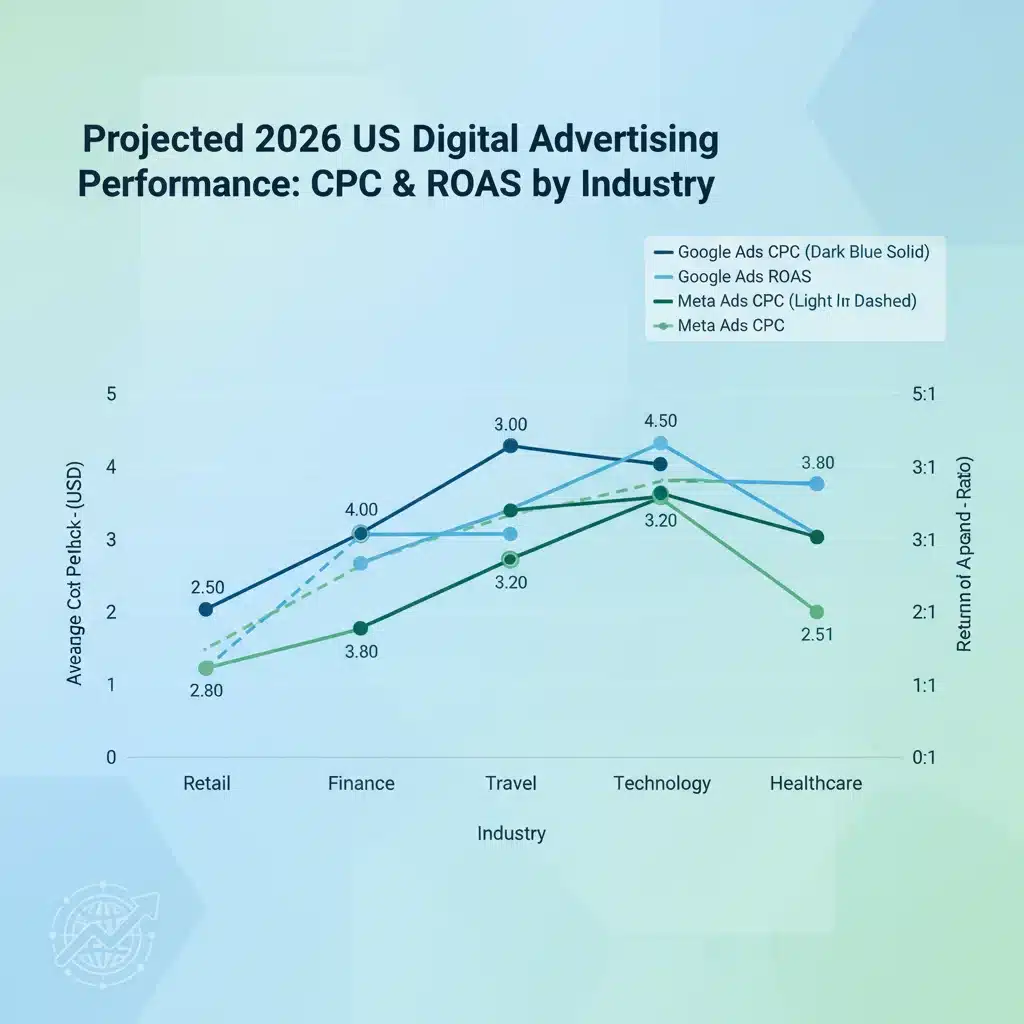
Google Ads primarily operates on a Cost Per Click (CPC) model, meaning you pay when someone clicks your ad. CPCs can vary wildly based on industry, keyword competition, and ad quality, often ranging from a few cents to several dollars. The ROI for Google Ads can be very high due to the strong purchase intent, but requires careful budget management to avoid overspending on competitive terms.
Meta Ads often utilizes a Cost Per Mille (CPM – cost per thousand impressions) or CPC model. CPMs tend to be lower than Google’s CPCs, allowing for broader reach. However, conversion rates might be lower initially because users aren’t actively searching. The ROI for Meta Ads often comes from building brand loyalty, generating leads further up the funnel, and remarketing efforts, which can lead to lower Cost Per Acquisition (CPA) over time, especially for products or services with a longer sales cycle.
Ad Formats and Creative Freedom
Google Ads offers a wide array of formats: text ads, responsive search ads, Shopping Ads (product listings), image display ads, video ads (YouTube), and app ads. While there’s creative freedom, especially in display and video, text ads are more constrained.
Meta Ads shines in creative flexibility. Image ads, video ads, carousel ads, collection ads, and Stories ads allow for highly engaging and visually appealing content. This platform is ideal for brands that rely heavily on visual storytelling and user-generated content to connect with their audience.
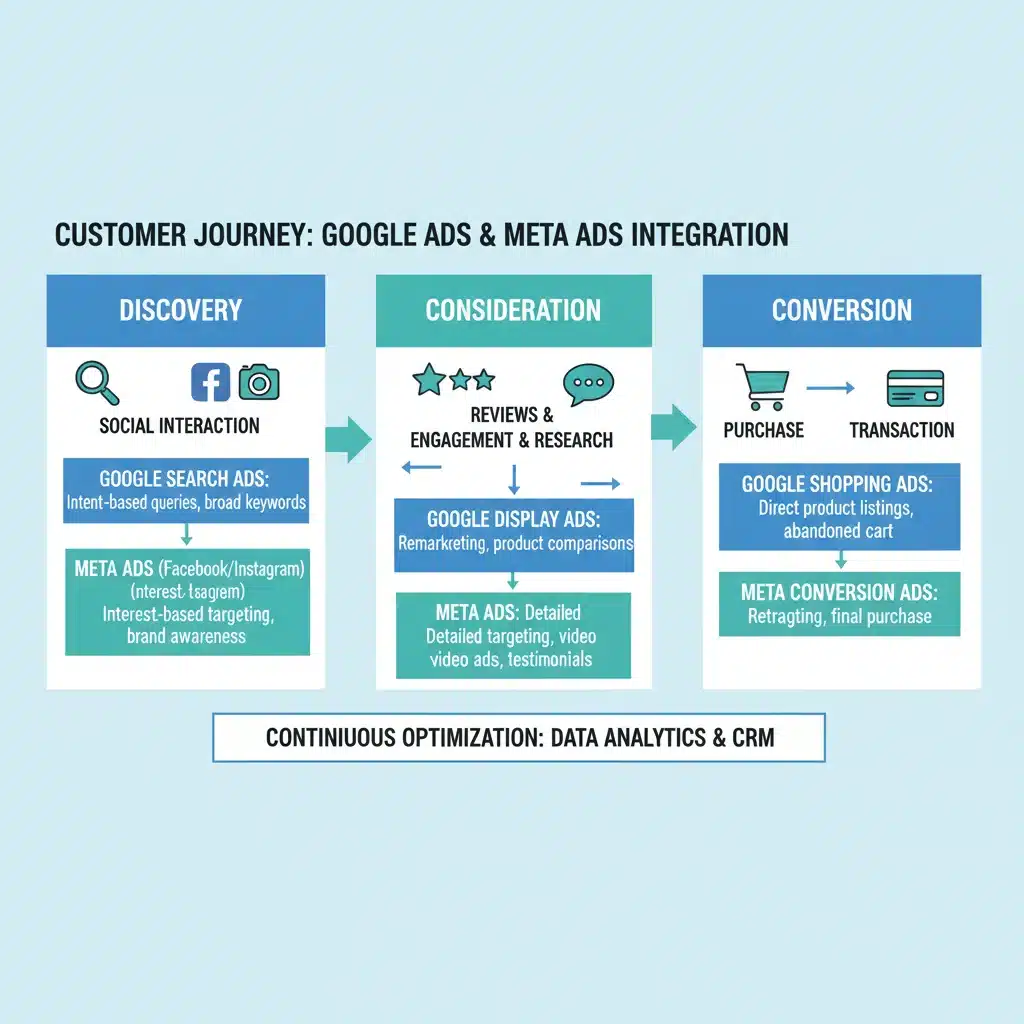
Position in the Customer Journey
Understanding where each platform fits into the customer journey is critical for US businesses:
- Google Ads: Primarily effective in the consideration and conversion stages. Users are actively researching or ready to buy, making it perfect for capturing bottom-of-funnel demand.
- Meta Ads: Excellent for the awareness and interest stages. It helps introduce products, build brand recognition, and generate initial interest before a user even knows they need a solution. It’s also powerful for remarketing to users who have previously engaged with your brand.
Data and Analytics
Both platforms offer robust analytics. Google Ads integrates seamlessly with Google Analytics, providing a holistic view of website traffic, conversions, and user behavior originating from ads. Meta Ads Manager provides detailed insights into ad performance, audience demographics, and engagement metrics. The key difference lies in the type of data: Google focuses on search behavior and website actions, while Meta provides deep insights into user interests and social interactions.
Strategic Allocation of Your Digital Ad Budget in 2026
For most US businesses, the question isn’t whether to choose Google Ads or Meta Ads, but rather how to effectively integrate both into a cohesive strategy. Here’s a framework for maximizing your digital ad budget in 2026:
1. Define Your Objectives Clearly
Before allocating budget, be explicit about your marketing goals. Are you aiming for:
- Brand Awareness? Meta Ads is often more cost-effective for broad reach and visual impact.
- Lead Generation? Both can work, but the approach differs. Google Ads for high-intent leads, Meta Ads for nurturing cold leads.
- Direct Sales/Conversions? Google Search Ads and Shopping Ads are typically strong performers for immediate conversions. Meta Ads can drive sales through strong calls to action and remarketing.
2. Understand Your Target Audience
Who are you trying to reach? If your audience is actively searching for solutions, Google Ads is paramount. If your audience spends significant time on social media and responds well to visual content and community, Meta Ads is indispensable. Consider their demographics, psychographics, online behavior, and where they spend their time online.
3. Full Funnel Strategy: A Synergistic Approach
The most effective strategy often involves using both platforms in a complementary fashion:
- Awareness (Top of Funnel): Use Meta Ads to introduce your brand and products to a broad, yet targeted, audience based on interests and demographics. Utilize engaging video and image ads.
- Consideration (Mid-Funnel): Continue with Meta Ads for remarketing to those who engaged with your awareness campaigns. Simultaneously, use Google Display Ads for remarketing and Google Search Ads for broader, informational keywords to capture users beginning their research.
- Conversion (Bottom of Funnel): Leverage Google Search Ads for high-intent, transactional keywords. Utilize Google Shopping Ads for e-commerce. Employ Meta Ads for highly targeted remarketing to users who have shown strong purchase intent (e.g., abandoned carts, viewed specific product pages).
4. Budget Allocation and Optimization
Start with a balanced budget, perhaps 50/50, and then adjust based on performance. Continuously monitor key metrics like CPC, CPA, ROAS, and conversion rates for both platforms. Be prepared to shift budget towards the platform or campaign that delivers the best ROI for specific objectives. A/B testing ad creatives, landing pages, and targeting parameters is crucial for ongoing optimization.
Emerging Trends and Future Outlook for 2026
AI and Automation
Both Google and Meta are heavily investing in AI and machine learning to automate campaign management, optimize bidding, and personalize ad delivery. Advertisers in 2026 will need to embrace these tools, learning how to effectively guide AI rather than manually controlling every aspect of a campaign. This means a greater focus on strategy, data interpretation, and creative development.
Privacy-First Advertising
With increasing privacy regulations and the move away from third-party cookies, first-party data will become even more valuable. US businesses should invest in robust Customer Relationship Management (CRM) systems and strategies to collect and leverage their own customer data for targeting and personalization on both Google and Meta platforms.
Video and Immersive Experiences
Video content will continue its dominance. Both platforms offer extensive video ad formats, and businesses should prioritize high-quality, engaging video creatives. While the metaverse is still evolving, early adoption of augmented reality (AR) filters on Meta and interactive ad experiences on both platforms could provide a competitive edge.
Performance Max and Advantage+ Campaigns
Google’s Performance Max and Meta’s Advantage+ shopping campaigns represent a shift towards more automated, goal-based campaign types that leverage AI across all available channels within their respective ecosystems. US businesses should explore these to simplify campaign management and potentially unlock new performance efficiencies.
Case Studies: Real-World Applications for US Businesses
E-commerce Business:
A US-based online fashion retailer uses Google Shopping Ads to capture high-intent buyers searching for specific clothing items. They simultaneously run Meta Ads campaigns showcasing new collections and lifestyle content to build brand awareness and drive traffic to their website, then retarget these visitors with specific product ads on both platforms. This integrated approach ensures they capture both existing demand and generate new interest.
B2B Software Company:
A US SaaS company uses Google Search Ads to target businesses searching for solutions to specific pain points their software addresses. For broader reach and lead generation, they employ Meta Ads to target decision-makers based on industry, job title, and interests, driving them to webinars or whitepapers. They then use remarketing on both platforms to nurture these leads through the sales funnel.
Local Service Provider:
A local plumbing company in a US city leverages Google Local Search Ads to appear at the top for “plumber near me” queries. They also use Meta Ads to target homeowners in their service area with ads offering seasonal maintenance tips and special discounts, building community trust and generating leads before an emergency arises.
Conclusion: A Harmonious Blend for 2026 Success
In conclusion, for US businesses looking to maximize their digital ad budget in 2026, the answer is not to choose between Google Ads and Meta Ads, but to strategically integrate them. Each platform possesses unique strengths that, when combined, create a powerful and comprehensive advertising strategy. Google Ads excels at capturing existing demand and driving immediate conversions, while Meta Ads is unparalleled for building brand awareness, generating demand, and fostering community.
By understanding the distinct roles each platform plays in the customer journey, defining clear objectives, and continuously optimizing based on performance data, US businesses can craft a synergistic approach that leverages the best of both worlds. The future of digital advertising in 2026 will reward those who are adaptable, data-driven, and willing to embrace a holistic Google Meta Ads strategy to achieve sustainable growth and superior ROI.
Invest in continuous learning, stay abreast of platform updates, and don’t be afraid to experiment. The digital landscape is dynamic, and your advertising strategy should be too. By mastering the intricate dance between Google Ads and Meta Ads, your business will be well-positioned for success in the competitive digital arena of 2026 and beyond.